When New Zealand's energy system needs gas at short notice, one of the country's most important energy assets - the Ahuroa Gas Storage Facility (AGS) is like a giant underground energy battery, quietly working behind the scenes to help keep the lights on across the country.
Located north-east of Stratford, the Ahuroa Gas Storage Facility stores natural gas deep underground and can quickly release it to support electricity generation when demand is high or renewable generation is low. At full withdrawal, Ahuroa can deliver enough gas each day to generate around 10 gigawatt-hours of electricity, which is equivalent to the average daily electricity use of around half a million New Zealand households.*
That’s what gas storage gives you — the ability to respond to demand with large volumes of gas and really quickly.
Owned by Flexgas, part of Clarus, Ahuroa is New Zealand's only dedicated underground gas storage facility. At a depth of 2,500 m - the same depth as Mt Taranaki is tall - it plays a vital role in helping balance the country's energy system.
We spoke to Dave Maetzig, AGS Operations Lead, about how underground gas storage works, how it supports the electricity sector, and why he's still learning new things even after 13 years at Ahuroa.
“Most New Zealanders will never see Ahuroa, but when electricity demand peaks or renewable generation is low, the facility is quietly working in the background to help ensure energy is available where and when it's needed most,” said Maetzig.
Like a bank – gas goes in and comes out when needed
Ahuroa was once an oil and gas field. Now that the oil and gas have been used up, it's an ideal place to store natural gas. Maetzig says it's not always easy to explain what Ahuroa is and what his job involves.
"When most of us think about gas storage, we think about home gas bottles or tanks. But underground gas storage is completely different. It’s not a tank, it’s not a hole in the ground, it’s a reservoir," explains Maetzig.
"Ahuroa was once an oil and gas field. Now that the oil and gas have been used up, it's an ideal place to store natural gas in a 15-metre-thick seam of porous rock, with hardened clay above and below it. At 2,500m, people are amazed at how deep it is."
"Ahuroa is filled up using compression. Three compressor units push natural gas into the porous rock and hold it there under pressure until it is needed. That pressure drives the gas back to the surface, where it is then processed through the extraction plant to meet the required gas specification," Maetzig explains.
"We doesn’t own any gas," he adds. "Ahuroa is like a bank. We hold onto our customers’ gas for them. Gas goes in, then it’s taken out when it’s needed. A customer can ring up and let us know they need gas, and we can respond immediately, delivering at rates of up to 2.75 terajoules per hour, or 65 terajoules per day (one terajoule provides energy to around 13,500–14,000 households for one day, based on 20 kWh/day).”
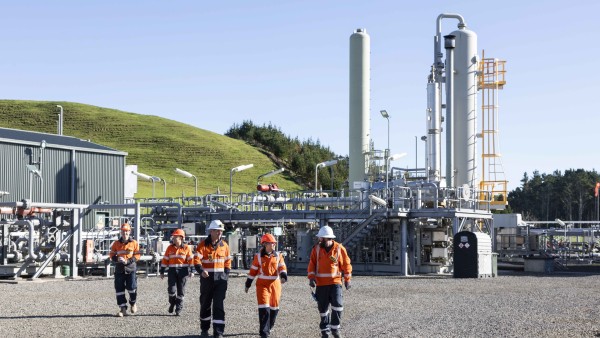
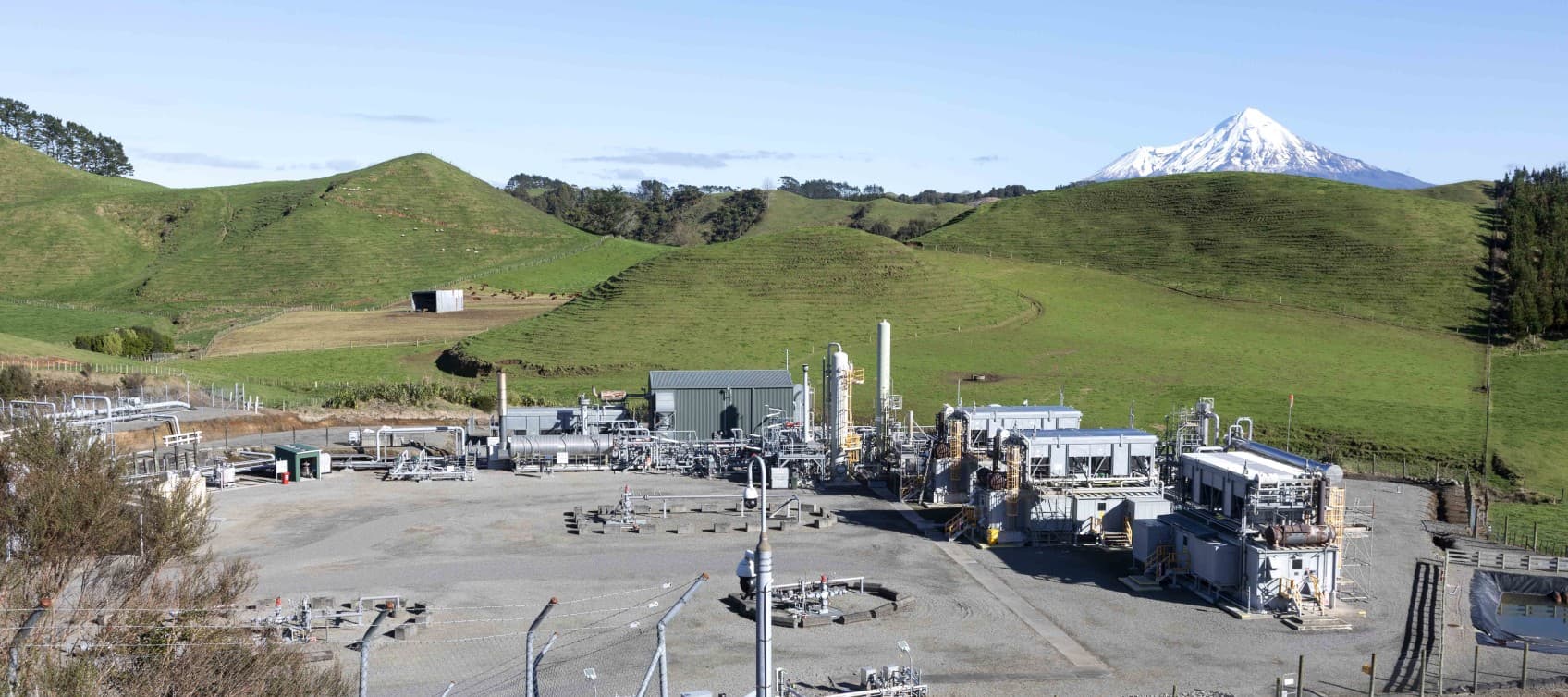
Photo: Ahuroa Gas Storage Facility, South Taranaki
Bridging the gap
Ahuroa effectively acts as a giant energy battery for New Zealand's gas market. It's not an easy matter for producers to ramp gas production up and down to match demand.
By making gas available when it is needed most, storage helps support a more reliable energy system and can help reduce some of the price volatility that occurs when supply and demand become out of balance.
"It's similar to what happens with a home solar system," Maetzig says. "When the sun is up, you can generate a lot of solar and store it in a battery. Ahuroa is a similar approach for gas producers - they store gas when the market isn't using it. This is something our country needs, and we may need more of it in future."
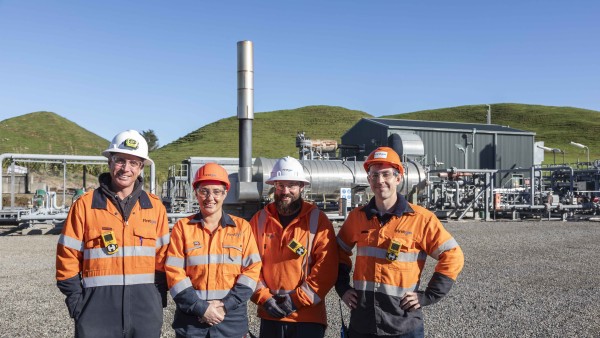
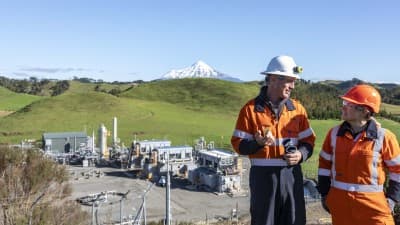
Photo: Members of the Ahuroa Gas Storage Facility team
Gas storage provides flexibility and supports a reliable energy system
Gas stored at Ahuroa helps support electricity generation when New Zealand needs it most. When hydro lake levels are low, renewable generation is reduced, or electricity demand increases, gas can be quickly released from Ahuroa to fuel power stations. This flexibility helps maintain a reliable electricity supply and contributes to a more stable energy market.
"The electricity supply in New Zealand is multilayered, and we should be leaning on renewable energy wherever possible," says Maetzig. "But we can't yet supply 100% renewable energy, or at least not without significant further investment. That means gas still has a place, and gas storage provides that flexibility."
"There’s never a dull moment, and after 13 years dedicated to this site, I’m still learning new things. We have a great team here, and we all take pride in keeping the facility available while maintaining extremely high health and safety standards.
"We don’t often think about what Ahuroa contributes to New Zealand, but it’s all part of the big energy picture, helping keep prices steady and keeping the lights on across the country".
* Calculation: Based on Ahuroa's maximum withdrawal capacity of 65 TJ/day. Assumes a modern gas-fired power station conversion efficiency of approximately 55%, resulting in around 10 GWh of electricity. Household equivalent is based on average New Zealand household electricity consumption of approximately 7,300 kWh per year (MBIE).